How Blue Line Elite Security is Modernizing Visitor Management Across 4 Communities
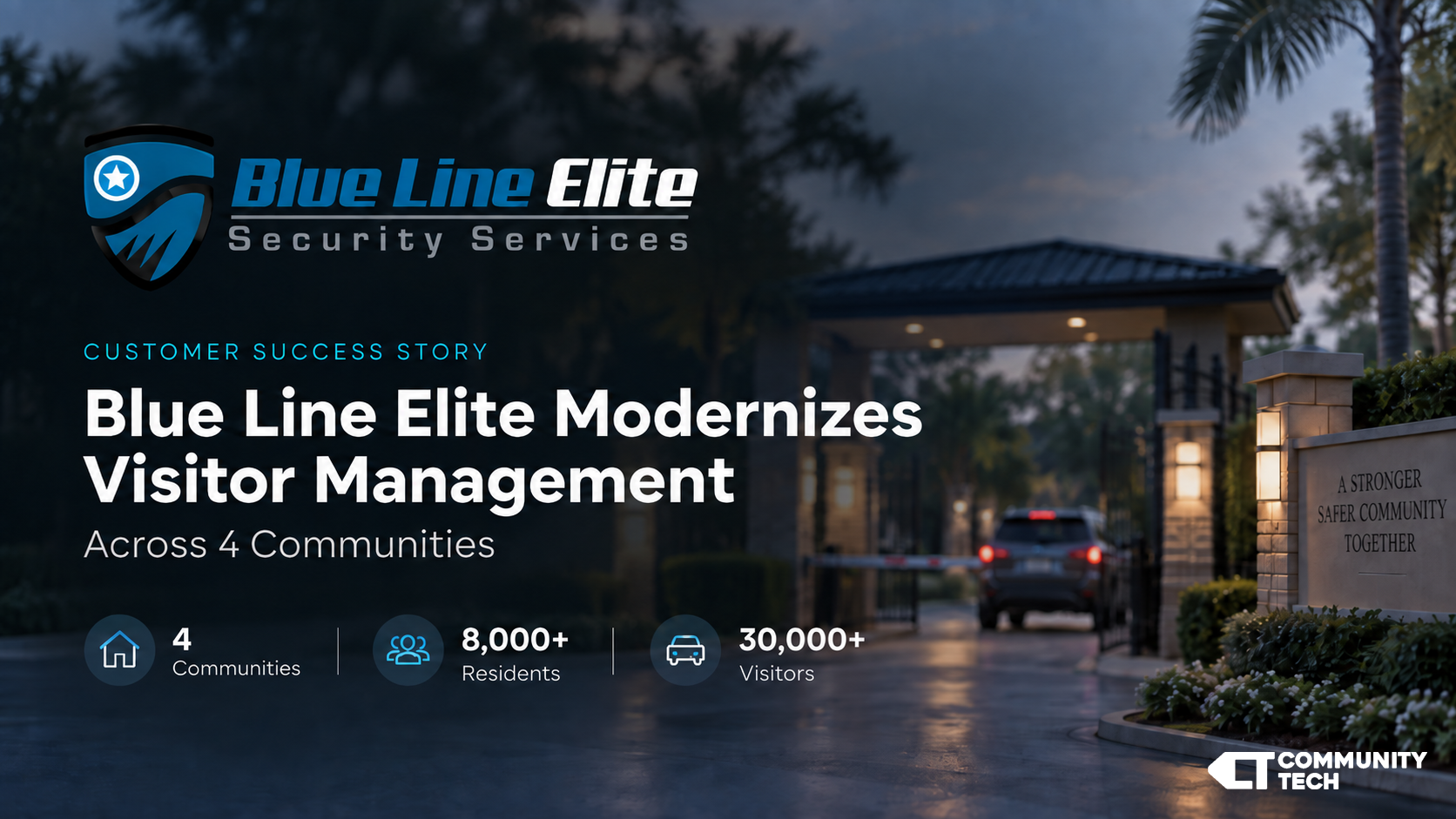
For about 15 years, Blue Line Elite Security Services relied on the same visitor management system to help manage access at the gated communities it served.
But eventually, longevity stopped feeling like stability.
Updates had slowed. Requested improvements weren't being addressed. Support had become increasingly difficult to get. And when Blue Line began exploring a move to a modern visitor management platform, another problem became clear:
Getting their own data out of the existing system was going to be much harder than expected.
That raised an uncomfortable question that every HOA, property manager, and security company should consider:
If you can't easily take your community's data with you when you leave a software provider, how much control do you really have over your data?
Blue Line Elite decided it was time for a change.
Community Tech helped the company transition four gated communities, more than 8,000 residents, over 30,000 frequent visitor records, and approximately 30 security guards from a 15-year-old legacy system to a modern, cloud-based visitor management platform.
And Community Tech handled the difficult part of the migration along the way.
The Story at a Glance
Client: Blue Line Elite Security Services
Industry: Residential Security / Guard-Gated Communities
Communities Migrated: 4
Residents Added: 8,000+
Frequent Visitors Migrated: 30,000+
Guards / Admins Using the System: ~30
Previous Visitor Management System: OnGuard
Solution: Community Tech GateWatch
Primary Goal: Replace aging visitor management technology while preserving years of resident and visitor data
The Challenge: When Long-Standing Software Stops Moving Forward
Using the same software for 15 years isn't necessarily a problem. In fact, software that continues improving alongside its customers can become an important long-term part of an organization's operations.
The problem comes when the business keeps evolving and the technology doesn't. According to Blue Line Elite, that was increasingly their experience with OnGuard.
The system had been part of their gated-community operations for 15 years, but meaningful product improvements had become increasingly difficult to identify.
Blue Line had ideas for how the platform could better support its communities and security personnel. But getting responses to questions, requesting improvements, or understanding what was coming next became increasingly difficult.
Over time, the lack of communication and visible product development became concerning enough that Blue Line's leadership began questioning the long-term future of the platform.
For a security company responsible for operating gated-community entrances every day, that uncertainty matters. Visitor management isn't a piece of software that gets opened once a month.
Guards rely on it. Residents rely on it. Property managers rely on it. Visitors interact with the process every day.
When the technology behind that operation stops evolving, the community can eventually feel the effects.
The Bigger Problem: Could Blue Line Take Its Data With It?
Once Blue Line decided to explore another visitor management platform, another issue surfaced.
Data…
Over 15 years, the existing system had accumulated an enormous amount of operational information. That included thousands of residents and tens of thousands of frequent visitor records used by the communities every day.
Blue Line needed that information to make the transition.
According to Blue Line Elite, getting assistance from its existing provider to export that information proved extremely difficult. And once it became clear that Blue Line intended to migrate to another platform, the process did not become easier. That created a bigger question than simply how to change software.
It created a question about data ownership.
Do You Actually Own Your Visitor Management Data?
Most communities would probably answer this question immediately:
Of course we own our data.
The residents are ours. The visitor records belong to the community. The vehicle records came from our residents. The system contains information generated through our operations.
But there's an important difference between theoretically owning information and practically being able to access it.
If changing providers requires cooperation from the company you're leaving, what happens when that cooperation isn't there?
If you can't easily export your resident directory, frequent visitor lists, vehicles, and other operational data in a usable format, switching platforms can become extraordinarily difficult.
And that creates a form of technology lock-in that communities may not realize exists until they decide to leave.
It's why we think every organization evaluating visitor management software should ask a simple question before signing a contract:
If we decide to leave someday, how do we get all of our data back?
The answer shouldn't be complicated.
Your Community's Data Shouldn't Be a Retention Strategy
There are plenty of good reasons a software company should want customers to stay: a strong product, responsive support, regular improvements, new capabilities, and a relationship customers value. Making it difficult for customers to access or move their own operational data should not be one of them.
At Community Tech, we believe your community’s data belongs to your community. The software should make that information easier to use and manage, not create dependency simply because switching platforms is difficult. That belief became especially important during the Blue Line Elite migration.
Community Tech Took Ownership of the Migration
If you are evaluating a migration to a new system, the first question you should ask is “how does the new vendor help me through the process. Blue Line has plenty going on already in their day to day, and the last thing they needed was to spend months rebuilding four communities or asking thousands of residents to recreate information that already existed. Community Tech took ownership of the migration, working through the existing data, cleaning and organizing it, and preparing it for the new platform even when the outgoing provider was not making the process easy.
In total, Community Tech migrated more than 8,000 resident records and 30,000 frequent visitor records into the new system. That allowed all four communities to preserve years of important operational data and move forward without starting over.
Changing Software Shouldn't Mean Losing 15 Years of Information
This is one of the most overlooked parts of replacing legacy visitor management software. When organizations compare platforms, they naturally focus on features like digital guest passes, mobile access, resident self-service, and how quickly guards can find the information they need.
Those capabilities matter, but there is another question that should be part of the conversation from the beginning: What happens to all of the information already stored in your current system?
For established gated communities, a visitor management platform may contain years of resident records, frequent visitors, vehicles, contractors, vendors, access history, and other information used every day by guards and community staff. Replacing the software should not mean losing that history or rebuilding it from scratch.
A clear data migration plan should be part of any visitor management transition from day one.
Moving Four Communities at the Same Time
Blue Line’s migration came with an added layer of complexity because the rollout covered four separate communities, each with its own residents, visitors, security personnel, management needs, and day-to-day processes. Blue Line needed a platform that could support those differences while still giving its team a consistent system to use across its portfolio of gated-community clients.
Community Tech worked alongside Blue Line throughout the implementation, handling the data migration, configuring each community, setting up resident and visitor information, preparing guard workflows, training security personnel, and supporting the transition to the new platform.
The goal was not simply to replace one system with another. It was to give Blue Line a modern visitor management platform it could continue building on across its communities.
Training Everyone on the new system
Migrating the data was only one part of the transition.
The people using the technology every day also had to be comfortable with it.
Community Tech built our training material to assist Blue line in their process of needing to train thousands of residents, and all of their staff across the 4 communities.
That training focused on the workflows residents and guards actually use at the entrance, including finding residents, reviewing visitor information, processing entries, and working within the community's visitor management procedures.
For us, that's an important distinction.
Technology at a staffed entrance should make a security guard's job easier.
It shouldn't force a guard to become a software expert.
Modern Technology Without Removing the Human Element
There’s sometimes an assumption that modern visitor management technology is meant to replace the guard. We see it differently. Guards bring judgment and situational awareness that software cannot fully replace, so the technology should make their job easier by giving them better information and reducing unnecessary administrative work.
When residents can pre-authorize guests, visitor information is easier to find and verify. Searchable records help guards spend less time digging through outdated information, and cloud-based software makes it easier to improve the system over time. Giving residents better tools to manage their own visitors can also reduce routine calls and questions at the gate.
Modernization does not have to mean removing the guard. It can simply mean giving them better tools to do their job.
A Better Experience for Residents
Visitor management is technically a security operation, but residents experience it as customer service.
If a guest arrives and isn't expected, the resident may get a phone call.
If visitor information is wrong, the resident has to fix it.
If the system is confusing, residents avoid using it.
And if enough residents avoid using it, guards end up dealing with the consequences at the gate.
Blue Line wanted something easier for the residents its security teams serve.
Community Tech gave those communities a modern environment where residents, guards, and community management could work from the same visitor management platform.
The result has been a better experience for the people on both sides of the gate.
The Results
The Blue Line Elite rollout was more than a software replacement. It was a full operational transition across four gated communities, with the goal of preserving critical data, minimizing disruption, and giving both guards and residents a better experience.
Community Tech successfully migrated all four communities from OnGuard, bringing over 8,000 resident records and more than 30,000 frequent visitor records into the new platform. That allowed the communities to retain years of important information without asking residents or staff to start over.
At the same time, approximately 30 Blue Line Elite guards were trained on the new system so they could confidently use it as part of their day-to-day operations from the start.
Most importantly, Blue Line moved from a platform they felt had stopped evolving to a modern, cloud-based system that can continue to improve alongside their communities. Instead of simply solving the immediate need to replace OnGuard, the transition gave Blue Line a stronger technology foundation for the future.
The Lesson for Other Security Companies and HOAs
Blue Line's experience highlights an important lesson for any organization evaluating security or visitor management technology.
Don't only ask what the software does today.
Ask what happens tomorrow.
Ask:
How frequently is the platform improving?
Can you reach someone when you need support?
Does the company listen to customer feedback?
Can the platform evolve as your operations change?
Can you integrate other technology in the future?
Can you export all of your data if you decide to leave?
That last question may be one of the most important.
Because you shouldn't have to discover how portable your data is after you've decided to change providers.
Before Choosing Visitor Management Software, Ask About Your Exit
Most companies choose new software based on what it can do today, not what happens if they decide to leave years from now. But data portability should be part of that evaluation from the beginning.
Before choosing a visitor management provider, understand exactly how your data can be retrieved. Can you export your complete resident and visitor records? Will the information be provided in a usable format? Are there additional fees involved? Will the provider assist with the process, and is there any data you would not be able to take with you?
You may end up using the same platform for the next 15 years, and ideally you will. But that should be because the provider continues to deliver value, improve the product, and support your organization—not because switching has become too difficult.
Blue Line Elite's Perspective
“Community Tech made the transition from OnGuard seamless. Their team handled the entire onboarding, has been super responsive to our needs, and delivered a solution our residents love.”
— Dominic Luciano, President, Blue Line Elite Security Services
Modern Visitor Management for Security Companies
Blue Line Elite's implementation included four gated communities, more than 8,000 residents, over 30,000 frequent visitor records, and approximately 30 guards.
But behind those numbers is a problem many organizations eventually encounter.
What happens when you've outgrown the technology your operations depend on?
Community Tech built GateWatch specifically around modern gated-community operations.
And when a community decides it's time to make a change, we don't believe migration should be an afterthought.
From extracting and organizing existing information to configuring the platform, training guards, and helping communities go live, our goal is to make switching systems considerably less intimidating.
Because choosing better software shouldn't mean starting over.
Considering replacing your current visitor management system?
See how Community Tech can help migrate your community and modernize your guard gate operations.