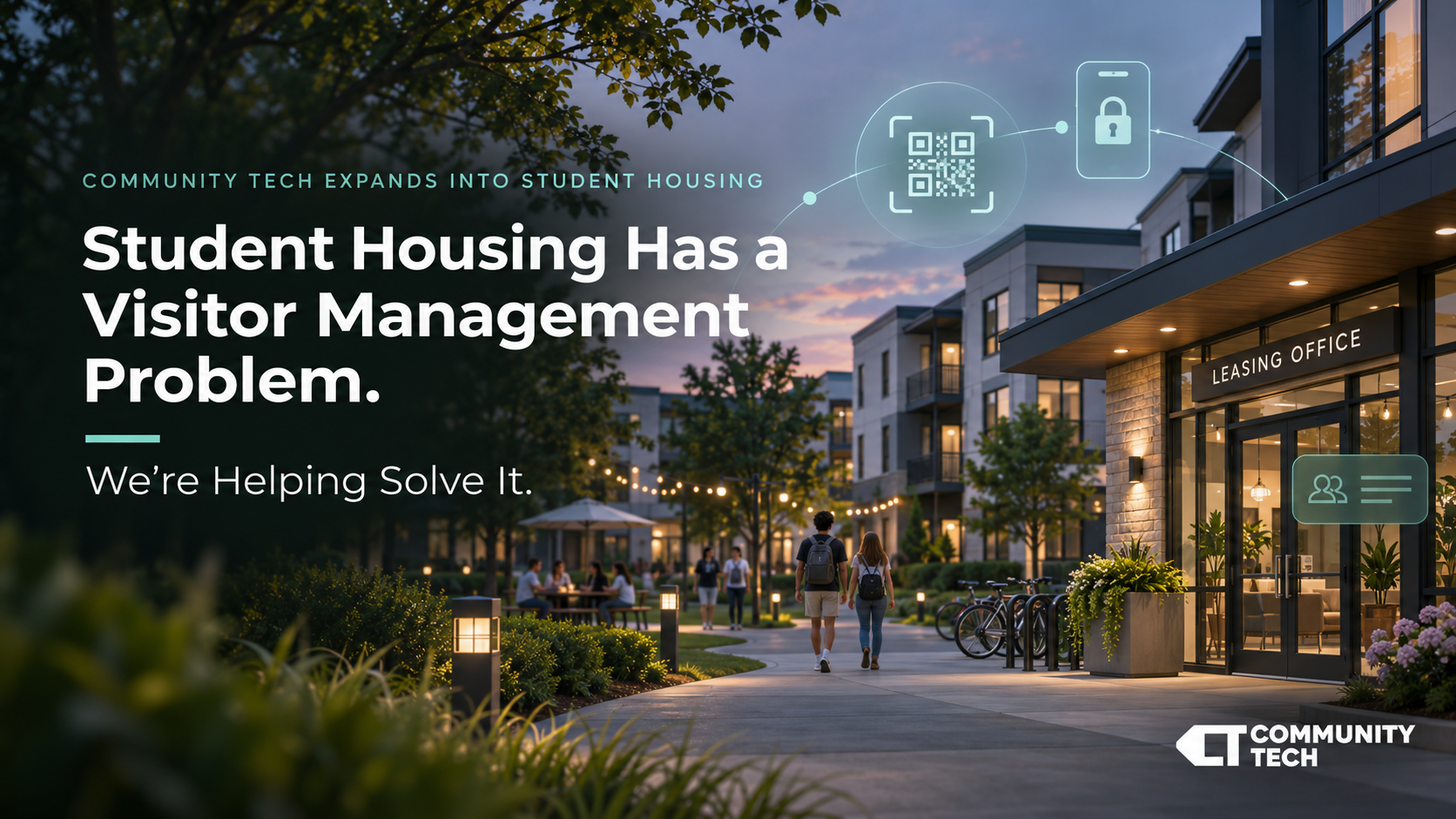
When we started building GateWatch, our focus was pretty simple. We hated waiting in line at a gate, and wanted to make visitor management easier and faster for gated communities, security teams, and the residents they serve. But the more we've worked with different communities, the more we've realized that visitor management isn't just a gated community problem, and the workflows vary at every property.
Student housing is actually a market we're pretty familiar with. Early in our careers, we worked at a student housing property near the University of Central Florida (UCF), where we got to experience firsthand what goes into operating these communities and some of the challenges that come with them. Parties, unauthorized guests, incidents on the property, and trying to enforce community rules were all part of the reality of managing student housing.
When something happens at a property, one of the first questions is often pretty simple: Who was on the property, and who were they visiting? You'd think that would be an easy question to answer, but unfortunately, that isn't always the case.
That's part of why we're excited to announce that Community Tech has officially expanded into student housing with the launch of GateWatch at University Village at Slippery Rock in Pennsylvania. It's a new market for our company, but one we have a personal connection to.
Student Housing Is a Different Kind of Community
Managing visitors at a student housing property is a little different than managing them at a traditional HOA. In a typical gated neighborhood, you might have a family that's lived in the same home for 15 years. They have their regular visitors, maybe a housekeeper or landscaper, and the occasional guest coming over.
Student housing is a completely different environment. You might have four students sharing an apartment, all with different schedules and different guests. Friends are visiting after class, parents are coming for the weekend, and deliveries are arriving throughout the day. When the school year ends, a significant portion of your residents might move out, with an entirely new group moving in just a few months later.
That's a lot of information for a property to manage, but there's another side of student housing operations that makes visitor management even more important: accountability.
Anyone who's worked in student housing knows that parties and unauthorized gatherings can become an issue pretty quickly. What starts as a few friends hanging out can turn into a much larger gathering, sometimes involving people who don't even live at the property. That can lead to noise complaints, property damage, parking problems, and in more serious situations, criminal activity.
When those situations happen, the property management team is often left trying to piece together what happened afterward. Who were the guests? Which residents invited them? Were they authorized to be there? Had they visited before? Without a consistent visitor management process, answering those questions can be incredibly difficult.
Having visitor management software isn't going to magically stop parties or prevent crime. However, having an accurate record of registered and checked-in visitors gives property managers and security teams more information to work with when incidents occur. That's an important distinction, and one of the reasons we believe visitor management is so valuable in student housing.
Enforcing Property Rules Shouldn't Be a Guessing Game
Another thing we remember from working in student housing is how important enforcing property rules can be. Most student housing communities have policies around guests, whether that's limiting how many visitors a resident can have at one time, restricting the number of overnight stays, or requiring guests to be registered before entering the property.
Whatever those rules are, they're only useful if the property has a way to consistently enforce them.
Let's say a property limits how many nights a guest can stay within a given month. How does the management team know when someone has exceeded that limit? If the property is relying on paper logs, spreadsheets, or disconnected systems, it can be pretty difficult to track. Even if the security team is doing a great job checking people in, that information doesn't do much good if property managers can't easily access it later.
This is where having visitor information connected to residents and units becomes valuable. With GateWatch, properties can maintain visitor history, see which residents have authorized guests, and review relevant entry activity. That gives management and security teams a better starting point when reviewing potential policy violations or investigating incidents.
Of course, visitor records are only as accurate as the check-in processes behind them, and software doesn't replace the people responsible for enforcing the rules. But it does give those people better tools and information to work with. That's something we wish more properties had access to when we were working in student housing ourselves.
Students Want Convenience. Properties Still Need Control.
Students are used to doing just about everything from their phones. They order food, pay bills, communicate with friends, and manage pretty much their entire lives digitally. So why should managing a visitor be any different?
If someone wants to have a friend over for the weekend, they shouldn't have to jump through a bunch of unnecessary hoops to make it happen. But at the same time, property managers need to know who's authorized to visit, which resident they're visiting, and whether that visitor is following the property's rules.
Those two things shouldn't be mutually exclusive. You can make it easier for residents to have guests while giving property teams better visibility into what's happening at their community. That's the balance we want to help properties achieve with GateWatch.
One of the biggest things we've focused on while building GateWatch is making the visitor management process as simple as possible for everyone involved. Not just the property manager or security guard, but also the residents and their guests.
For example, let's say a student has a friend coming to visit for the weekend. Instead of contacting the leasing office or asking someone to manually add their guest to a list, they can create a digital guest pass through GateWatch. They select the visitor, determine when the pass should be valid, and send it directly to them. When the guest arrives, the property's security team or authorized staff can validate that pass as part of the property's established check-in process.
If that same guest comes back regularly, residents can manage them as a frequent visitor rather than having to start over every time. For property teams, that means having visitor information, resident directories, and entry history organized in one place instead of digging through old records trying to figure out who someone was visiting or whether they were authorized to be there.
We've also recently introduced scheduling capabilities that allow guest passes created in advance to be delivered closer to the date they're actually needed. It's a relatively small feature, but one that solves a real problem. Just because you're planning for a visitor two weeks from now doesn't mean they need their access information today.
These are the kinds of improvements we want to keep making. Not technology for the sake of technology, but features that solve actual operational headaches.
Bringing GateWatch to University Village at Slippery Rock
We're excited to welcome University Village at Slippery Rock as one of the newest communities using GateWatch. Located near Slippery Rock University in Pennsylvania, University Village offers off-campus student housing with two- and four-bedroom apartment options.
It's a great example of how the communities we're supporting are beginning to expand beyond the traditional HOA and gated community market. While GateWatch was originally built with security teams and gated neighborhoods in mind, many of the core challenges are the same regardless of the type of property. You still have residents, visitors, and people responsible for keeping everything organized. The difference is how those communities operate and what they need from the software.
Having worked in student housing earlier in our careers, it's particularly exciting to now be building technology for an industry we understand from personal experience. We know how much goes on behind the scenes at these properties and how much responsibility falls on the teams managing them. Our goal is to give those teams tools that make their jobs easier while creating a better experience for the residents who live there.
We're looking forward to learning from our expansion into student housing, continuing to improve GateWatch, and finding new ways to support the people managing these properties. More importantly, we're excited about what this means for where Community Tech is heading.
Visitor Management Is Just Where We're Starting
Something we've talked about quite a bit internally is that we don't want Community Tech to be just a visitor management company. That's where we started, and it's a problem we're going to continue solving, but our vision is a lot bigger than that.
Think about all the different systems people interact with in their communities. You might have one app for managing visitors, another for paying rent or HOA dues, another for submitting maintenance requests, and yet another for receiving announcements. Then there are community events, resident groups, local businesses, and all the other things that make a neighborhood or apartment complex feel like an actual community.
Most of those experiences are completely disconnected, and we think there's an opportunity to bring a lot of that together.
Our mission at Community Tech is to connect and transform how people access, engage, and interact within their communities. Student housing is a particularly interesting market for that vision because these are residents who have grown up using technology for just about everything. They expect convenience, they want things to work, and they're generally comfortable adopting new tools.
Imagine being able to manage your visitors, RSVP to community events, get announcements from your property, connect with other residents, or even discover rewards from local businesses, all through one platform. That's the direction we want to go.
We're not there yet, and we're not pretending to be. We're still a small company building and improving our product every day, but every new community we launch brings us a little closer to that vision.
A New Market, Same Mission
Whether we're working with a 55+ gated community in Illinois, a vacation rental community in Florida, or now a student housing property in Pennsylvania, the goal is pretty much the same: make things easier for the people who live there and the people responsible for operating the community.
Our launch at University Village at Slippery Rock is particularly exciting because it brings us back to an industry we were part of early in our careers. We've experienced some of the challenges of managing student housing firsthand, and now we have an opportunity to build technology that helps solve them.
We're excited to welcome University Village to Community Tech and continue expanding into new markets. Student housing is a new chapter for us, and we're just getting started.
Managing a student housing property or residential community?
We're building GateWatch to make visitor management simpler for residents, property managers, and security teams. Learn more about GateWatch or get in touch with our team to see how Community Tech can help your community.