Why End-of-Year Is the Most Important Time to Audit Your HOA Tools
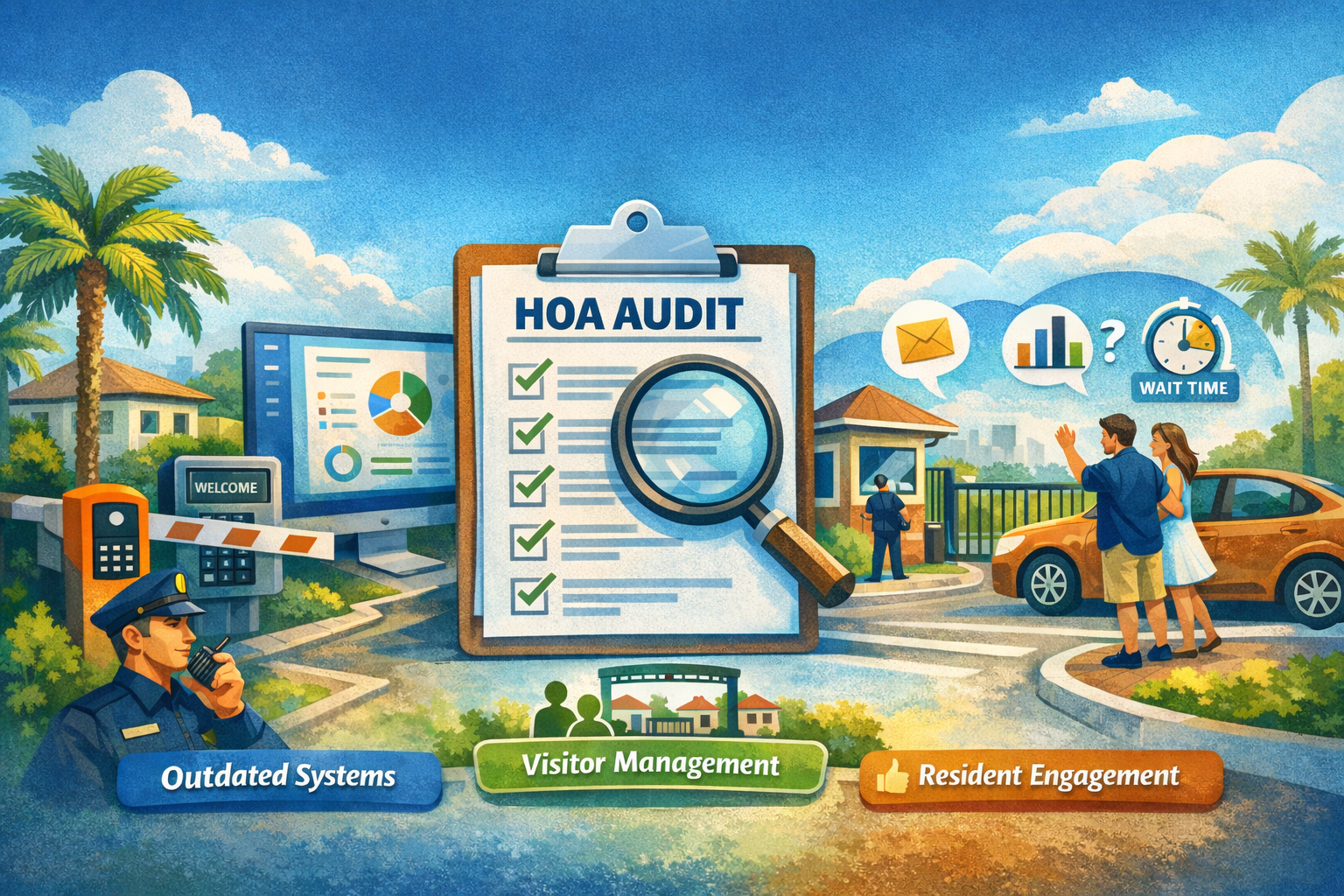
As the year winds down, most HOA boards and property managers are focused on budgets, renewals, and planning for the year ahead. But there’s one critical task that often gets overlooked, and it can quietly cost your community time, money, and resident trust:
Auditing your HOA technology stack.
From accounting software to access control, visitor management, resident communication tools, and amenity booking systems, many communities rely on a patchwork of platforms to get through the day. This leaves you and your residents juggling between systems to get anything done. With the year winding down, it’s the ideal time to step back and ask a simple but powerful question:
Are these tools actually working for your community, or are they just adding complexity?
The Hidden Cost of Too Many Systems
The bloated tech stack is not something that is unique to the HOA space. Over time, in any industry, there is the need to continue adding new technology as problems occur. These are often near sighted decisions due to an urgent need, and you’re unable to thing strategically about the big picture. At the end of the year, you go to audit your tech stack and you realize you have an accumulation of technology and forgotten tools.
The result is often:
Multiple logins for staff and board members
Disconnected data across systems
Manual workarounds and duplicated effort
Low resident adoption
Frustration at the gate and in the office
When systems don’t talk to each other, your team becomes the integration layer. A very expensive integration later at that. On top of the manual time it takes to get any sort of useable data out of these tools, you’re also not able to make real time decisions based on what’s going on in your community. In the age of AI, data is king, and relying on integrations to various systems, or excel spreadsheets to compare data puts you at risk.
Visitor Management: The Most Overlooked System to Audit
Visitor management is one of the most visible parts of community operations, yet it’s often the most outdated.
Across the country, residents and visitors regularly report waiting 30 minutes to several hours just to enter gated communities due to manual processes, outdated access systems, or poor coordination at the gate . These delays don’t just create frustration—they impact safety, resident satisfaction, and even access to essential services.
When auditing your visitor management system, ask:
Are guards relying on paper lists or verbal confirmations?
Can residents easily send guest access in advance?
Do visitors move through the gate quickly and securely?
Can the system integrate with existing call boxes or access hardware?
Do we have real data on wait times and visitor volume?
If the answer to most of these is “no” or “not really,” it’s a sign the system is holding your community back.
Are Residents Actually Using the Tools You Pay For?
Another key audit question: adoption.
You can have the best software in the world, but if residents aren’t using it, the value disappears. End-of-year is the right time to step back and look at how your tools are actually being used day to day. Are residents logging in regularly? Are core features like guest passes, announcements, and online payments being used or ignored? Are support tickets piling up, or are staff still handling tasks manually that were supposed to be automated?
When adoption is low, it usually points to one of three issues. The tool may not be intuitive, it may not solve a real problem residents care about, or there may simply be no incentive for residents to change their behavior.
This is why modern community platforms are starting to rethink engagement altogether.
At Community Tech as an example, we started as a visitor management company to allow residents to pre-authorize their guests. The act of sending a key to a guest is a feature that multiple companies offer today, but if none of the residents use it, the long guard gate still persists. That’s why we built an entire program around rewarding residents for key features.
Why Incentives Matter More Than Ever
Forward-thinking communities are moving beyond “just providing software” and toward motivating behavior.
When residents are rewarded for everyday actions—like picking up packages on time, paying dues digitally, or sending guests QR access instead of calling the gate—adoption increases naturally. Those small actions compound into:
Fewer bottlenecks at entrances
Less manual work for staff
Better compliance
Happier residents
Auditing your tools means evaluating not just what they do, but whether they encourage the behavior your community actually wants.
End-of-Year Audit = Smarter Decisions Next Year
An HOA technology audit doesn’t have to be complicated. Start with a simple checklist:
What systems do we currently use?
What problems were they meant to solve?
Are they integrated—or siloed?
Are residents and staff actively using them?
Where are we still relying on manual processes?
The goal isn’t more technology—it’s better, connected technology that works together to support residents, guards, and management alike.
Building Toward a More Connected Community
At Community Tech, we started by solving one very visible problem: long, frustrating visitor lines. What we discovered was a much bigger opportunity—to help communities operate as a single, connected system rather than a collection of disconnected tools.
As you plan for the year ahead, end-of-year is the perfect time to audit, simplify, and modernize your HOA tools—especially visitor management. Your residents, staff, and even your guards will feel the difference on day one.